Insulation and coil wrapping · reflow and solder masking · ESD and EMI control · display light sealing — ten tape families for electronics production, manufactured at Songyang's own plant in Houjie, Dongguan, China.
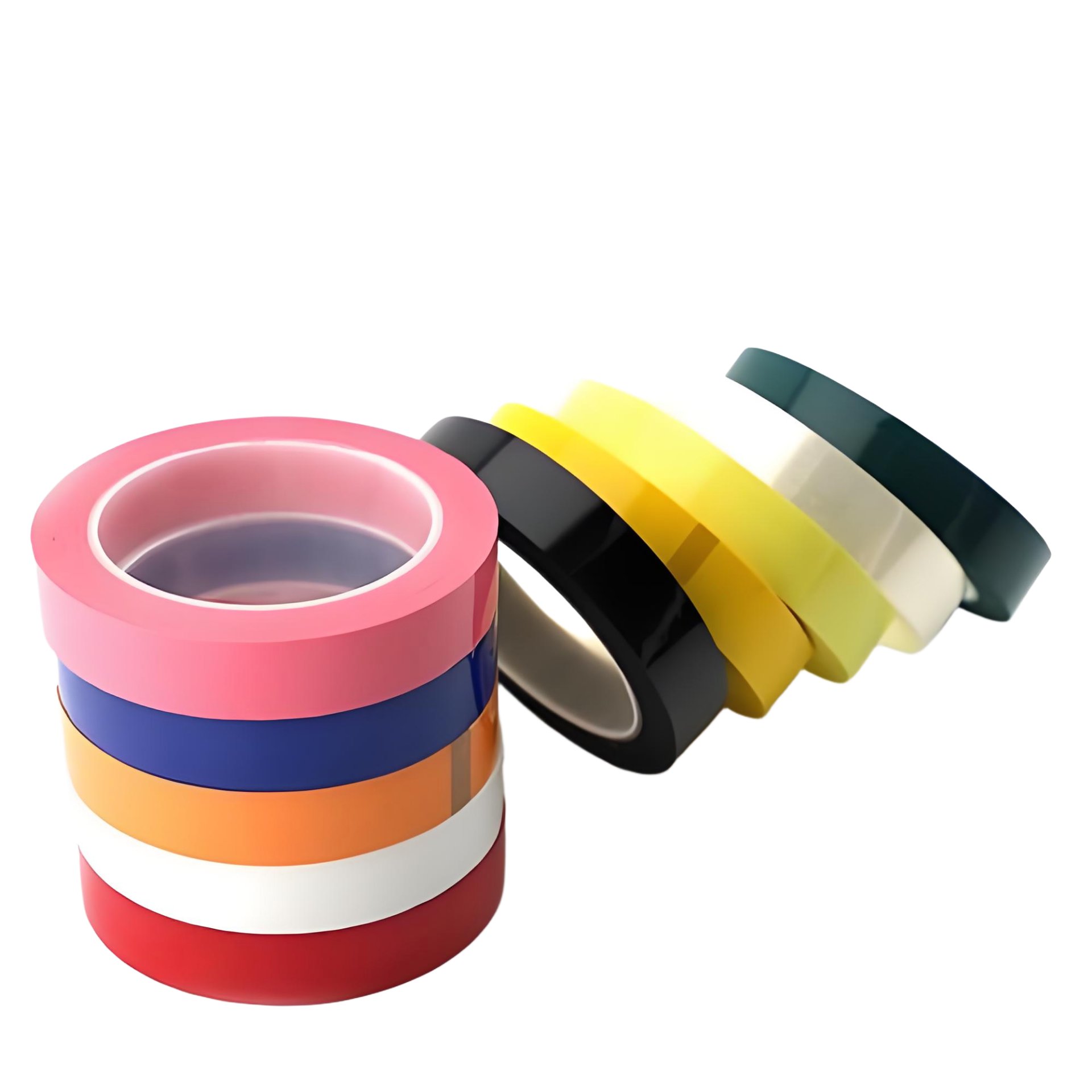
Electronic tape is functional material, not general-purpose tape: each family is specified by what it must insulate, dissipate, conduct or block. Songyang's series covers three groups — insulation and heat resistance (polyester (PET) film, polyimide (PI), acetate cloth, transformer margin tape), anti-static and conductive shielding (anti-static, conductive copper foil, conductive fabric, conductive foam) and assembly (light-shielding tape).
Production runs in-house at Songyang's Dongguan, China plant — compounding, coating, converting, slitting and QC across 16 production lines — so international buyers source electronic tape factory-direct instead of through a trading layer.
Wrapping transformer, motor, coil and capacitor windings, and building the margins that hold primary and secondary apart.
PET film · acetate cloth · margin tapeMasking gold fingers, solder joints and fine components through reflow and wave soldering, then releasing without rework.
Polyimide (PI) tapeDissipating static in PCB and cleanroom handling, and grounding or shielding enclosures, chassis seams and cable runs.
Anti-static · copper foil · fabric · foamSealing light at the edges of backlight and LCD modules without conducting — a precision die-cut part rather than a general tape.
Light-shielding tapeTen tape families, grouped by what they do in the build. Typical values are listed — the grade, width and adhesive system for your design are confirmed against the specification sheet.
| Group | Product | Backing / construction | Key properties | Typical use |
|---|---|---|---|---|
| Insulation & heat resistance | Polyester (PET) film tape | PET film + acrylic PSA | Insulating to 130 °C (266 °F), flame retardant, 55 µm and 80 µm, multiple colors | Transformer, motor and coil wrapping; capacitor insulation |
| Polyimide (PI) tape | Polyimide film + silicone PSA | 260–300 °C (500–572 °F) intermittent, clean removal; antistatic grade available | Reflow and wave-solder masking of gold fingers and fine components | |
| Acetate cloth tape | Halogen-free acetate cloth + acrylic PSA | Hand-tearable and conformable; absorbs varnish and resin; 0.20 mm total | Layer insulation and bundling in coils, transformers and wire harnesses | |
| Flame-retardant acetate cloth tape | Halogen-free acetate cloth + acrylic PSA | Flame retardant, about 80 °C (176 °F), solvent resistant | Coil and capacitor insulation where a flame-retardant grade is required | |
| Transformer margin tape | PET film / non-woven composite + rubber or acrylic PSA | Single, double and triple layer — 0.15 / 0.28 / 0.45 mm; breakdown 5.5 / 10 / 14 kV | Building winding margins and bobbin barriers; isolating primary from secondary | |
| Anti-static & conductive shielding | Anti-static tape | Transparent BOPP (OPP) film + acrylic PSA | Surface resistance 1.00×10⁶–1.00×10⁹ Ω; black grid, yellow grid, transparent; 0.060 mm total | PCB handling, component packaging and cleanroom marking |
| Conductive copper foil tape | Copper foil + conductive or non-conductive acrylic PSA | Resistance ≤ 0.05 Ω; shielding effectiveness 70–90 dB; solderable; 20–200 µm | Enclosure grounding, EMI shielding, signal-path protection | |
| Conductive fabric tape | Nickel / copper-coated polyester fabric + conductive acrylic PSA | Low surface resistance; shielding effectiveness 90 dB at 10 MHz; flexible and conformable | Chassis seams, cable bundles and irregular surfaces; conductive bonding | |
| Conductive foam | PU foam + nickel / copper coating + conductive adhesive | Surface resistance ≤ 0.05 Ω; compressible; fills gaps; −20 to 105 °C (−4 to 221 °F) | EMI gasketing and grounding across chassis and cover gaps | |
| Assembly | Light-shielding tape | Black PET film + acrylic PSA | Fully opaque; non-conductive on the adhesive side; 0.045 mm total | Backlight (BLU) and LCD module light sealing and fixing |
Four families that wrap, separate and protect windings. The backing sets the temperature ceiling; the adhesive decides whether the tape survives varnish impregnation and baking.
A PET film backing with an acrylic pressure-sensitive adhesive. Dimensionally stable and firm enough to convert cleanly, it is the general-purpose winding insulation — transformers, motors, coils and capacitors — and doubles as edge insulation and component fixing on boards. A flame-retardant version is supplied, and the film takes a wide color range for identification and layer marking. The family is also sold as Mylar tape; Mylar is a DuPont registered trademark for biaxially oriented PET film, and Songyang supplies the generic polyester (PET) equivalent.
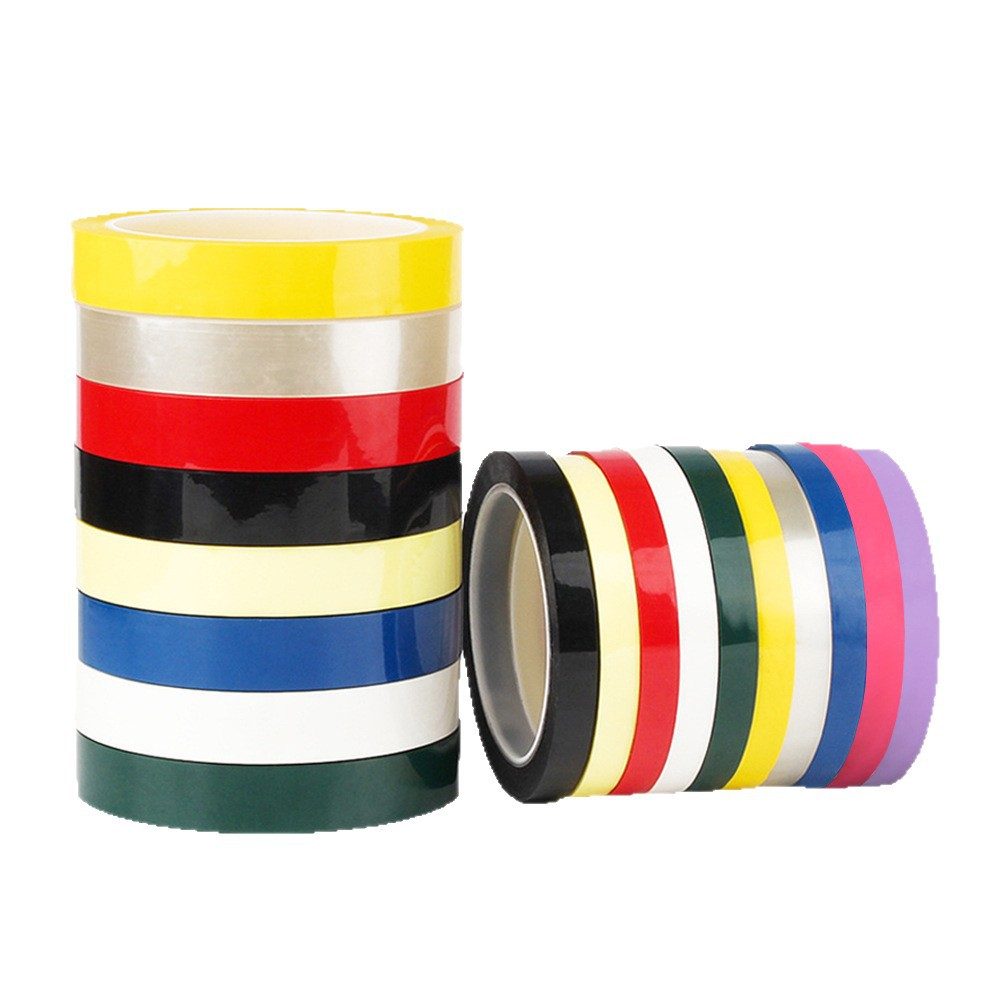
| Property | 55 µm tape | 80 µm tape |
|---|---|---|
| Backing | PET film | PET film |
| Adhesive | Acrylic PSA | Acrylic PSA |
| Colors | Pale yellow, white, transparent; red, blue, black, orange and green to order | Red, blue, black, white, pale and deep yellow, orange, green, transparent |
| Backing thickness | 25.0 ± 2.0 µm | About 50 µm |
| Total thickness | About 55 µm | 0.08 ± 0.01 mm (80 ± 10 µm) |
| Initial tack (steel ball) | ≥ 3 | — |
| 180° peel adhesion | ≥ 300 N/m (about 7.5 N/25 mm) | ≥ 250 N/m |
| Tensile strength | ≥ 44 N/10 mm | ≥ 88 N/10 mm |
| Elongation | ≥ 70% | ≥ 80% |
| Dielectric breakdown | ≥ 4.0 kV | ≥ 5.0 kV |
| Oven temperature | About 130 °C (266 °F) | 130 °C (266 °F) |
| Cold resistance | ≤ −1 °C (30 °F) | ≤ −10 °C (14 °F) |
| Length | 66 m ± 1 m (216 ft), slit to width | 50 m ± 0.5 m (164 ft), slit to width ± 0.20 mm |
Typical values, measured at about 25 °C (77 °F) and 65% RH. Exact figures for your batch, color and slit width are confirmed on the specification sheet or against a physical sample.
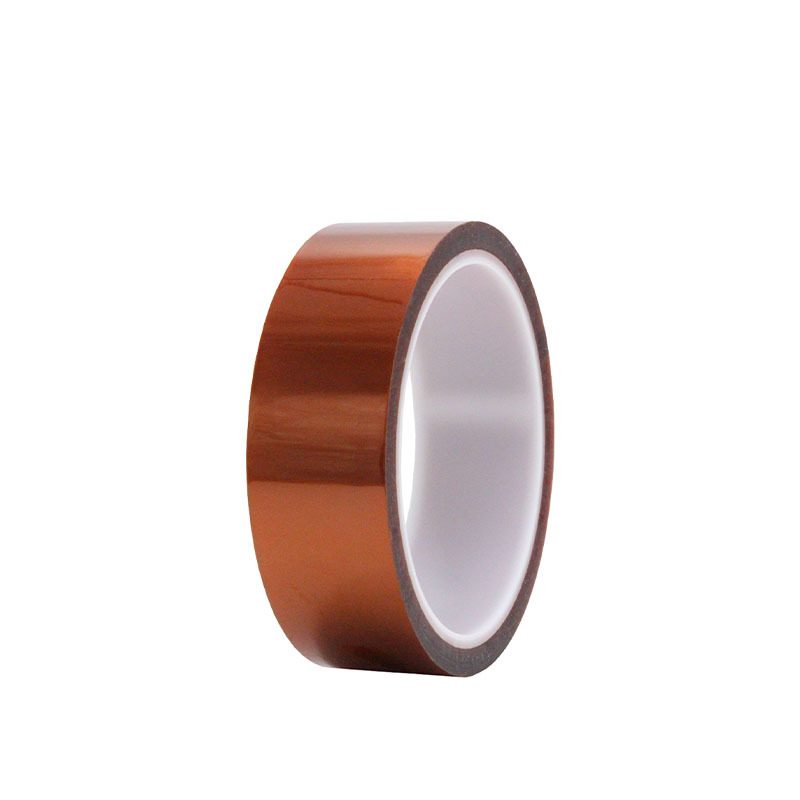
A polyimide film backing with a silicone adhesive, stable to 260–300 °C (500–572 °F) in short process peaks. It masks gold fingers, solder joints and fine components through reflow and wave soldering, then releases cleanly — no edge lift, no adhesive squeeze-out. Two grades are supplied: a standard insulating grade, and an antistatic grade for ESD-sensitive assembly areas. The family is also sold as Kapton tape; Kapton is a DuPont registered trademark, and Songyang supplies the generic polyimide equivalent. Grade, thickness and slit-width detail is on the high-temperature tape page.
| Property | Typical value |
|---|---|
| Backing | Polyimide (PI) film, Kapton-type |
| Adhesive | Silicone |
| Thickness | 1–2 mil (25–50 µm) |
| Color | Amber |
| Temperature | 260–300 °C (500–572 °F) intermittent |
| Standard grade | Electrical insulation |
| Antistatic grade | Surface resistance 10⁶–10⁹ Ω — grade confirmed against your requirement |
| Removal | Clean removal after solder cycles |
| Typical use | Reflow and wave soldering; masking gold fingers, solder joints and fine components |
A halogen-free acetate cloth backing with an acrylic pressure-sensitive adhesive. Soft, hand-tearable and highly conformable, it absorbs insulating varnish and resin — which is why it is the standard choice for coil wrapping and layer insulation on windings that are impregnated and baked afterwards. Used on transformers, motors, capacitors and wire harnesses. A flame-retardant version is supplied in white and black where a flame rating has to be met.
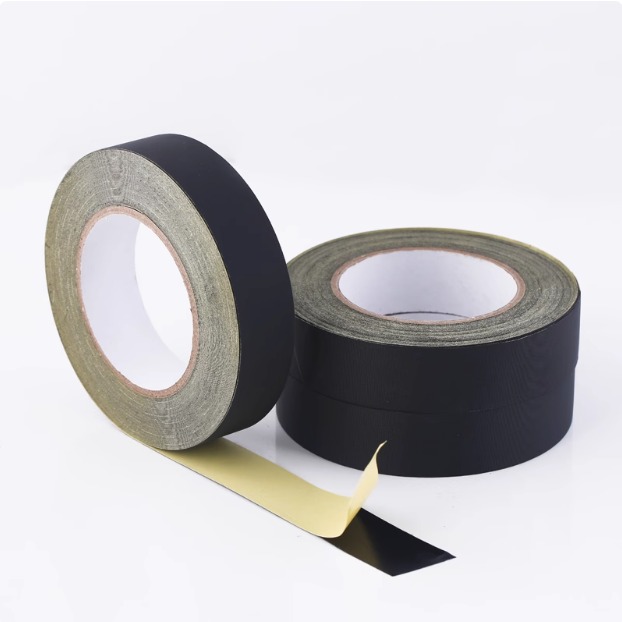
| Property | Standard (non-flame-retardant) | Flame-retardant (white / black) |
|---|---|---|
| Backing | Halogen-free acetate cloth | Halogen-free acetate cloth |
| Adhesive | Acrylic PSA | Acrylic PSA |
| Colors | White / black | White / black |
| Cloth thickness | 0.17 ± 0.005 mm | 0.17 ± 0.005 mm |
| Total thickness | 0.20 ± 0.005 mm | 0.20 ± 0.005 mm |
| Width | 1,270 mm (50 in), slit to order | 1,270 mm (50 in), slit to order |
| Liner | Yellow single-silicone release paper | Yellow single-silicone release paper |
| Initial tack (steel ball) | ≥ 8 | ≥ 8 |
| 180° peel strength | About 1,500 gf/in | About 1,000 gf/in |
| Holding power | > 48 h | > 48 h |
| Temperature | About 80 °C (176 °F) — no edge lift at the bond, no cracking on wrapped sections | About 80 °C (176 °F) |
| Dielectric strength | About 1.5 kV | About 1.5 kV |
| Flame rating | Non-flame-retardant | Flame retardant |
| Storage | Cool, ventilated, out of direct sunlight | About 6 months at 25 °C (77 °F) and 65% RH |
Typical values measured at about 25 °C (77 °F) and 65% RH — for reference only and not an acceptance criterion. Test before use in a critical application.
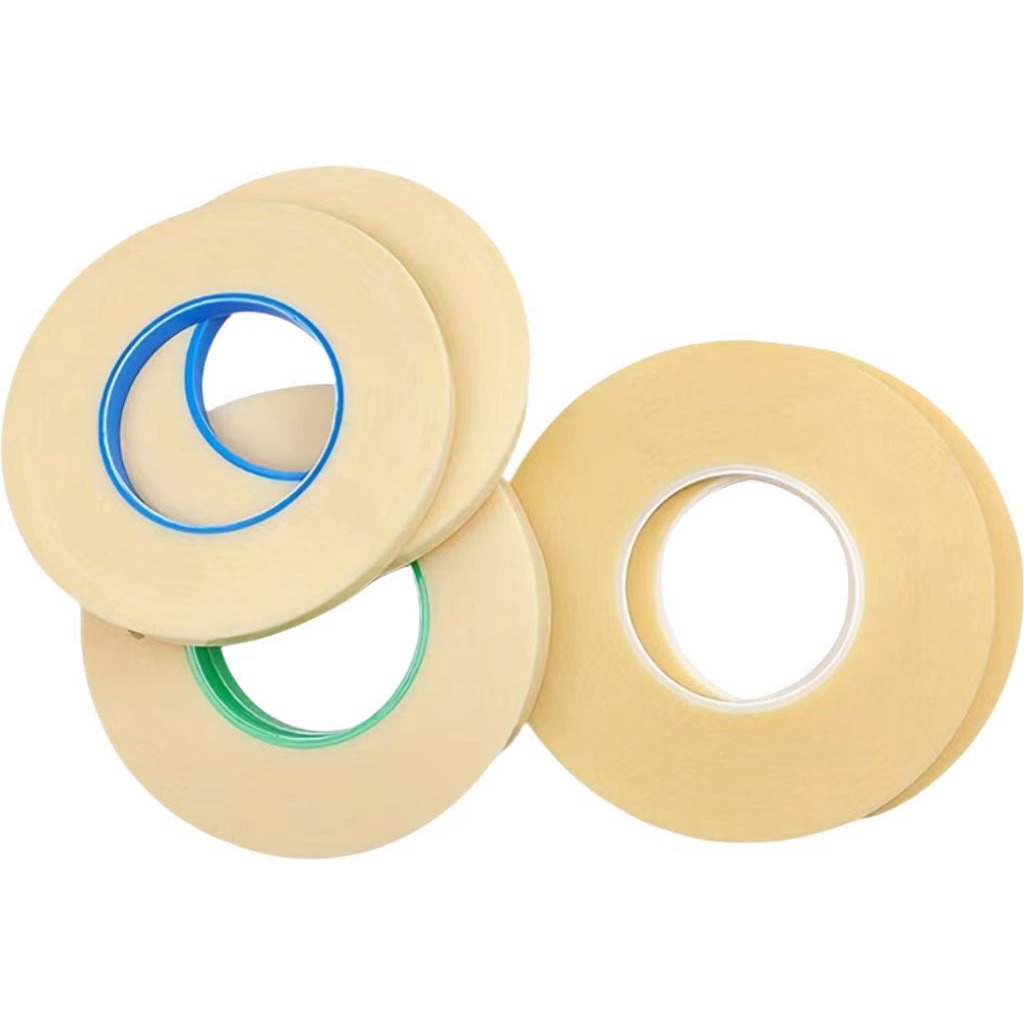
A composite of PET film and non-woven fabric with a rubber or acrylic adhesive, supplied in single, double and triple layer builds. It is wound onto the bobbin to build the margin that establishes the creepage distance between primary and secondary windings and insulates the ends of a winding. The non-woven face absorbs varnish and impregnating resin; the PET film carries the dielectric strength. Standard for switch-mode power supplies, adapters, high-frequency transformers and instrument transformers.
| Property | Single layer | Double layer | Triple layer |
|---|---|---|---|
| Backing | PET film / non-woven composite | ||
| Adhesive | Rubber or acrylic PSA | ||
| Color | Beige | ||
| Total thickness | 0.15 mm | 0.28 mm | 0.45 mm |
| Standard length | 90 m (295 ft) | 45 m (148 ft) | 30 m (98 ft) |
| Adhesion | About 4.4 N/10 mm | ||
| Breakdown voltage | About 5.5 kV | About 10 kV | About 14 kV |
| Typical use | Single bobbin margin and end insulation | Double margin and a longer creepage path | Triple margin for high-voltage isolation |
Used across UPS and switch-mode power supplies, dry-type and high-frequency transformers, microwave-oven transformers, electronic coils, switch-mode motherboards and motors including stepper motors. Typical values at about 25 °C (77 °F) and 65% RH — batch, slit width and adhesive system are confirmed on the specification sheet.
Two different jobs, frequently confused. Anti-static tape dissipates charge so it cannot damage a device; conductive tapes carry current, for grounding and for blocking interference. Specifying the wrong one is a common and expensive mistake.
A transparent BOPP (OPP) film with a static-dissipative treatment and an acrylic pressure-sensitive adhesive, supplied in a dissipative-on-both-sides build (backing surface and adhesive) and a single-side build (backing surface only). Surface resistance sits in the 1.00×10⁶ – 1.00×10⁹ Ω band, which is dissipative — charge drains in a controlled way instead of arcing across it. Used for PCB handling, component packaging, cleanroom marking and temporary fixing. Black grid, yellow grid and transparent are standard.
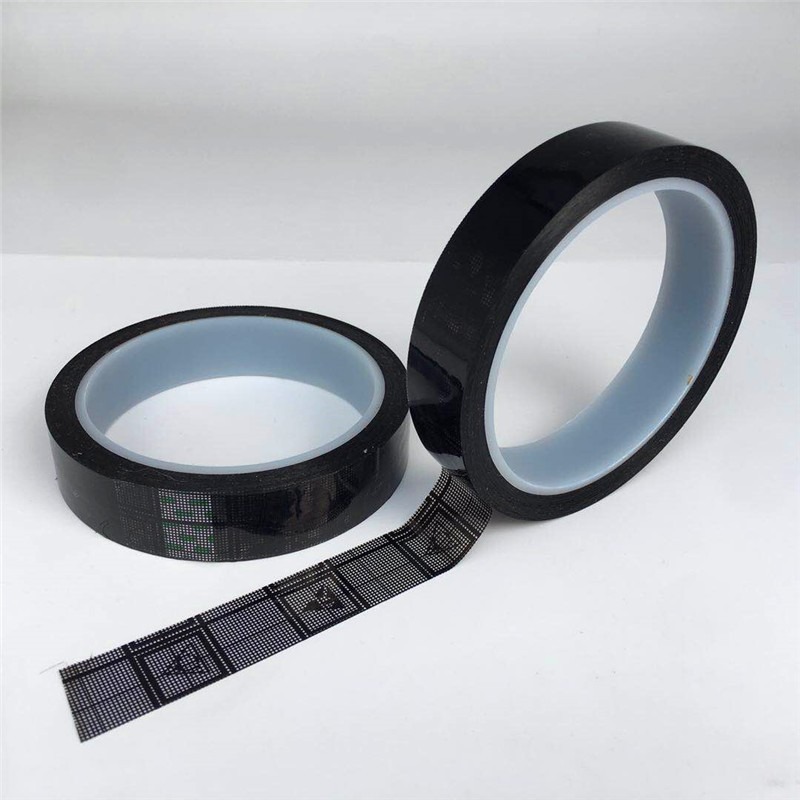
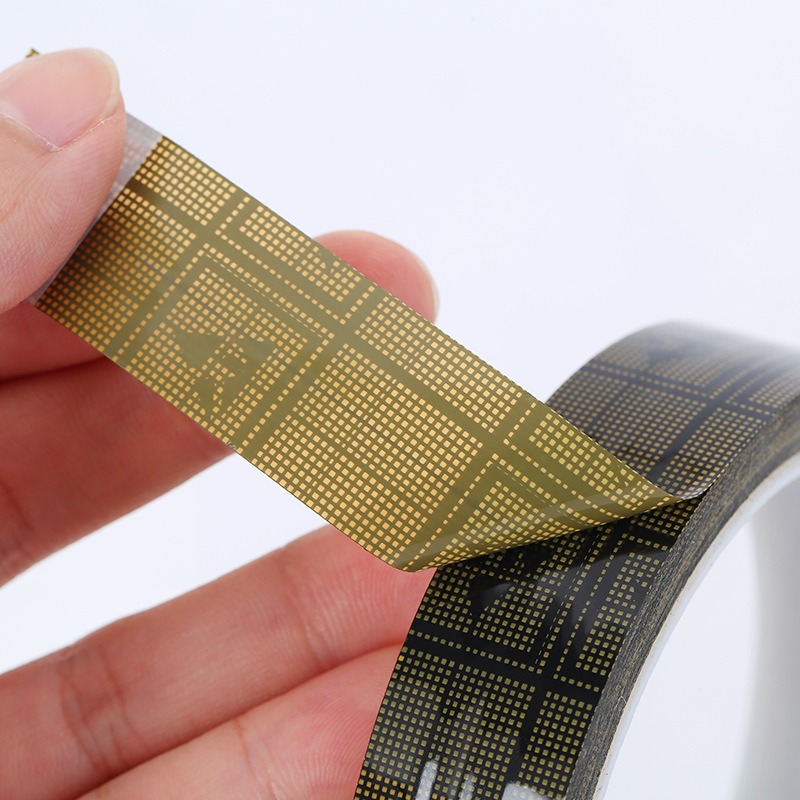
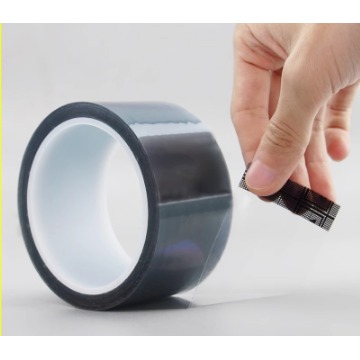
Color note: product color may differ slightly from the photographs — the physical sample is the reference.
| Property | Typical value |
|---|---|
| Static control | Dissipative on both the backing surface and the adhesive (single-side build available) |
| Backing | Transparent BOPP (OPP) film |
| Construction | BOPP film + static-dissipative / release layer + acrylic PSA |
| Colors | Black grid / yellow grid / transparent (same properties) |
| Backing thickness | 0.036 ± 0.002 mm |
| Adhesive thickness | 0.024 ± 0.002 mm |
| Total thickness | 0.060 ± 0.002 mm |
| Adhesion | > 800 gf/25 mm |
| Surface resistance | 1.00×10⁶ – 1.00×10⁹ Ω |
| Service temperature | −15 to 70 °C (5 to 158 °F) |
| Storage | About 1 year at 23 ± 5 °C (73 ± 9 °F) and 55 ± 10% RH |
Copper foil with a pressure-sensitive adhesive, for EMI shielding, grounding and signal-path protection. The specification that matters is the adhesive. Conductive adhesive carries current through the bond, so overlapping seams stay electrically continuous — which is what makes a shield actually work. Non-conductive adhesive grounds only where the copper touches bare metal; it is the lower-cost option for soldered or mechanically contacted joints. Buyers comparing Chinese catalogue names will see tapes without conductive adhesive listed as single-conductive and those with it as double-conductive.
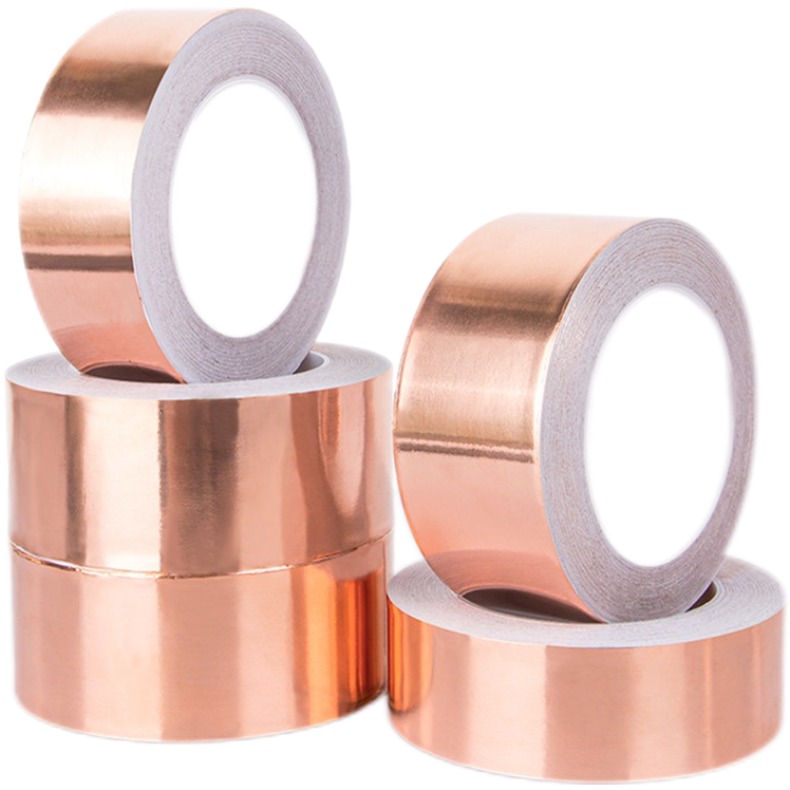
| Property | 20 µm | 50 µm | 60 µm | 85 µm | 150 µm | 200 µm |
|---|---|---|---|---|---|---|
| Foil thickness | 9 ± 1 µm | 18 ± 2 µm | 25 ± 3 µm | 50 ± 3 µm | 100 ± 2 µm | 150 ± 2 µm |
| Adhesive | Conductive (current passes through the adhesive) or non-conductive (copper face only) | |||||
| Resistance | ≤ 0.05 Ω | |||||
| 180° peel adhesion | ≥ 0.8 kg/25 mm | ≥ 0.8 kg/25 mm | ≥ 1.2 kg/25 mm | ≥ 1.2 kg/25 mm | ≥ 1.5 kg/25 mm | ≥ 2.0 kg/25 mm |
| Holding power | ≥ 48 h | |||||
| Continuous temperature | 80 °C (176 °F) | |||||
| Short-term temperature | 120 °C (248 °F) | |||||
The column headings are the total tape thickness — a 20 µm copper foil tape measures about 20 µm overall. Slit width, liner type and RoHS or halogen-free grades are made to order.
The 50 µm build above, shown in full. Useful when a design is being checked against a measured data sheet rather than a range.
| Property | Typical value |
|---|---|
| Backing | Conductive copper foil, purity ≥ 99.97% |
| Foil thickness | 0.018 ± 0.001 mm |
| Adhesive | Conductive acrylic PSA |
| Adhesive thickness | 0.03 ± 0.003 mm |
| Total thickness | 0.05 ± 0.005 mm |
| Liner | 0.14 mm white, 140 g, double-coated double-silicone |
| Color | Copper |
| Vertical resistance | ≤ 0.05 Ω/in² |
| Surface resistance | ≤ 0.05 Ω/in² |
| Adhesion | ≥ 1.3 kgf/in (about 1,420 gf/in measured at 180°) |
| Shielding effectiveness | 70–90 dB (10 MHz – 3 GHz); about 133 / 130 / 125 dB measured at 1 / 2 / 5 GHz |
| Holding power | ≥ 48 h |
| Thermal conductivity | ≥ 400 W/(m·K) |
| Temperature | Short term −20 to 120 °C (−4 to 248 °F); continuous −10 to 80 °C (14 to 176 °F) |
| Surface roughness Ra | ≤ 0.2 |
| Jumbo roll | 380 mm × 50 m / 100 m |
RoHS compliant, with halogen-free grades available. No oxidation after 20 minutes at 120 °C (248 °F). Values are for the 0.05 mm build — other thicknesses and slit widths are confirmed on the specification sheet.
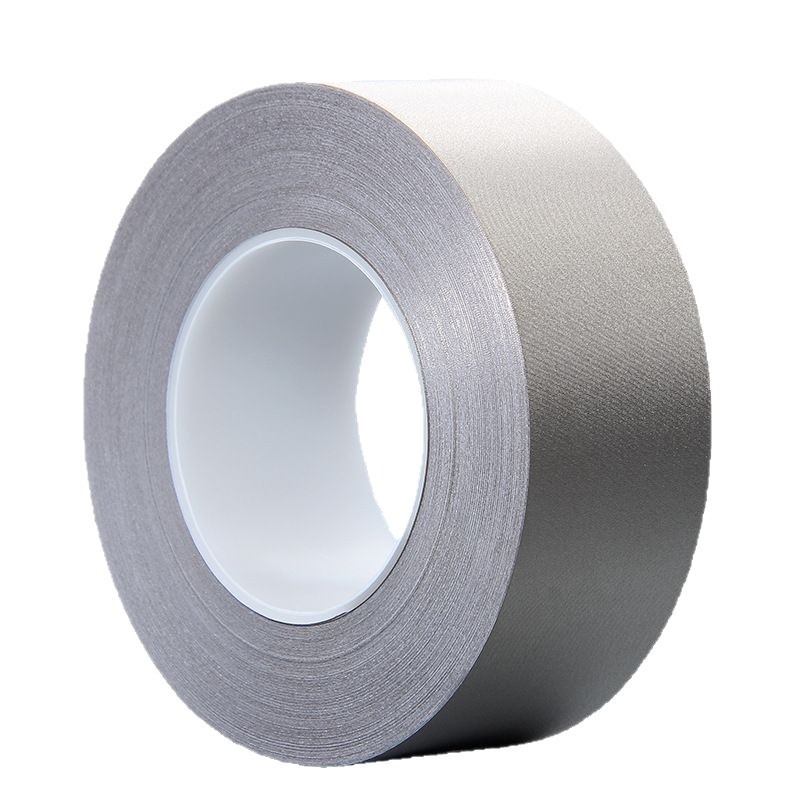
Nickel- or copper-coated polyester fabric with a conductive acrylic adhesive. Thin, flexible and conformable, so it wraps cable bundles and follows irregular surfaces where a foil would crease — while keeping a continuous conductive path. Supplied in five thicknesses from 0.05 mm to 0.25 mm.
| Property | 0.05 mm | 0.10 mm | 0.12 mm | 0.15 mm | 0.25 mm |
|---|---|---|---|---|---|
| Fabric thickness | 0.03 mm | 0.08 mm | 0.08 mm | 0.12 mm | 0.23 mm |
| Resistance | ≤ 0.05 Ω | ≤ 0.05 Ω | ≤ 0.05 Ω | ≤ 0.05 Ω | ≤ 0.05 Ω |
| 180° peel adhesion | ≥ 1.2 kg/25 mm | ≥ 1.2 kg/25 mm | ≥ 1.5 kg/25 mm | ≥ 1.5 kg/25 mm | ≥ 1.5 kg/25 mm |
| Holding power | ≥ 48 h | ≥ 48 h | ≥ 48 h | ≥ 48 h | ≥ 48 h |
| Continuous temperature | 80 °C (176 °F) | 80 °C (176 °F) | 80 °C (176 °F) | 80 °C (176 °F) | 80 °C (176 °F) |
| Short-term temperature | 120 °C (248 °F) | 120 °C (248 °F) | 120 °C (248 °F) | 120 °C (248 °F) | 120 °C (248 °F) |
| Property | Typical value |
|---|---|
| Backing | Nickel / copper-coated polyester conductive fabric |
| Fabric weight | 65.5 g/m² |
| Fabric thickness | 0.08 mm |
| Adhesive | Conductive acrylic PSA |
| Adhesive thickness | 0.045 mm |
| Total thickness | 0.10 mm |
| Adhesion | 1.0 kg/in |
| Tensile strength | 20 / 12 kg/in (JIS L 1096) |
| Tear strength | 0.28 / 0.20 kg (JIS L 1096) |
| Elongation | 17 / 19% (JIS L 1096) |
| Surface resistance | Initial 0.05 / 0.08 Ω/sq; after 100 h at 60 °C (140 °F) and 90% RH 0.06 / 0.09 Ω/sq; after 24 h salt spray at 35 °C (95 °F) 0.12 / 0.16 Ω/sq |
| Shielding effectiveness (E-field) | 90 dB at 10 MHz; 75 dB at 100 MHz; 60 dB at 500 MHz (KEC method) |
| Color | Purple — confirm against the specification sheet or a sample |
| Storage | About 6 months at 25 ± 5 °C (77 ± 9 °F) and 50 ± 30% RH |
The fabric face can oxidise on contact with skin oils — handle with gloves and avoid scratching the surface. Values are for the 0.10 mm build.
Polyurethane foam wrapped in a nickel / copper conductive layer, with a conductive adhesive on one face. It does what a foil cannot: it compresses and recovers, so it holds a stable conductive path across chassis and cover gaps that vary with assembly tolerance, vibration and thermal expansion. Supplied as a profile from 0.3 mm thick and 1.5 mm wide, cut to length.
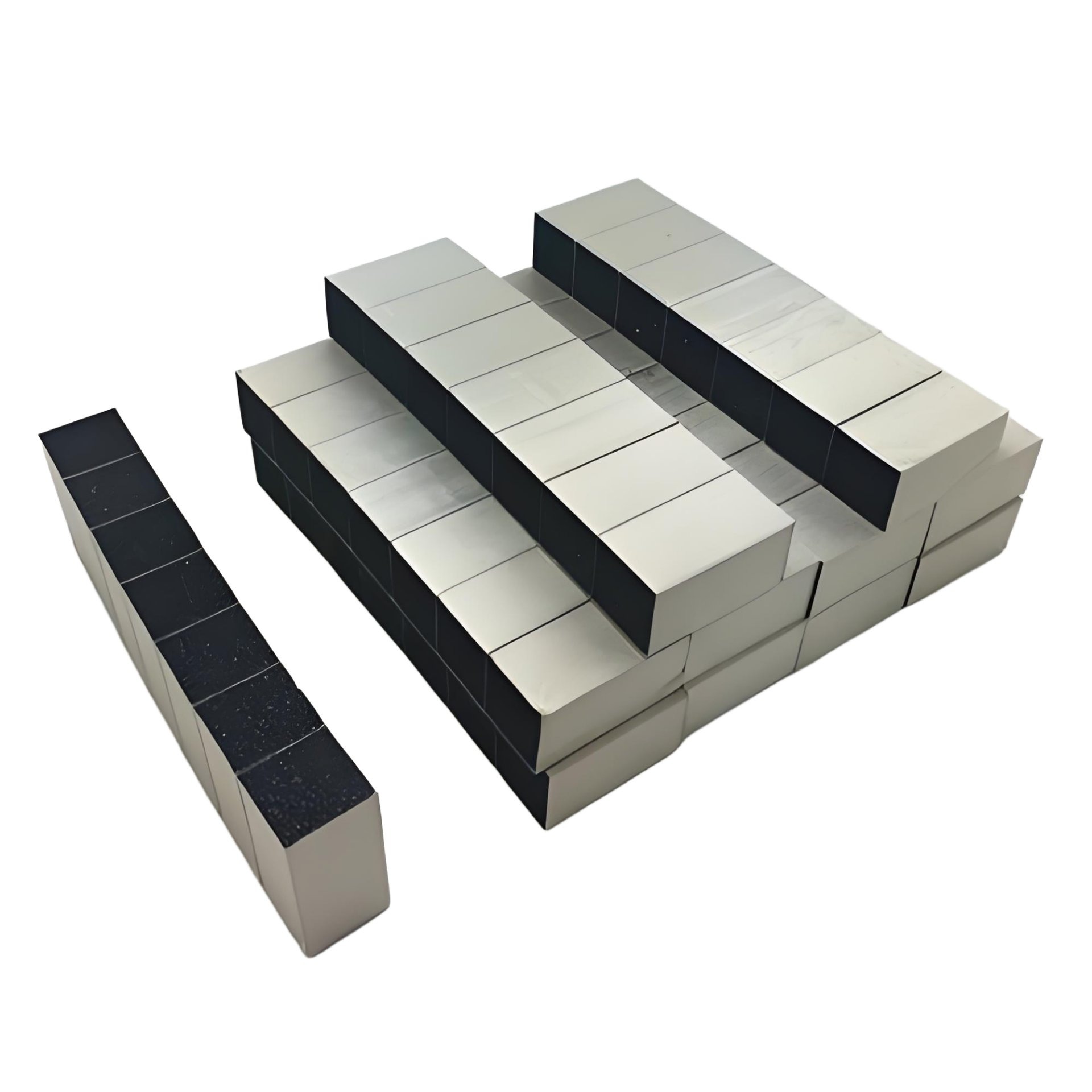
| Property | Typical value |
|---|---|
| Construction | PU foam + nickel / copper conductive layer (PET fiber 55–70%, copper 15–20%, nickel 12–20%) + single-side conductive adhesive |
| Weight | 140 ± 10 g/m² |
| Thickness | From 0.3 mm (± 0.2 mm) |
| Width | From 1.5 mm (± 0.3 mm) |
| Length | Cut or die-cut to order |
| Surface resistance | ≤ 0.05 Ω |
| Adhesion | 1,200 gf/25 mm |
| Shielding effectiveness | Tested over 10 MHz – 3 GHz (GJB 6190-2008) |
| Abrasion resistance | ≥ 10,000 cycles (ASTM D4966) |
| Service temperature | −20 to 105 °C (−4 to 221 °F) |
| Ignition point | 250 °C (482 °F), self-extinguishing |
| Appearance | Smooth silver-gray |
| Storage | About 12 months at 23 ± 2 °C (73 ± 4 °F) and 65 ± 5% RH, out of direct sunlight |
Gloves and a mask are recommended during converting. Values are typical of the specification and property sheet; thickness, width and die-cut tolerances are confirmed on the data sheet.
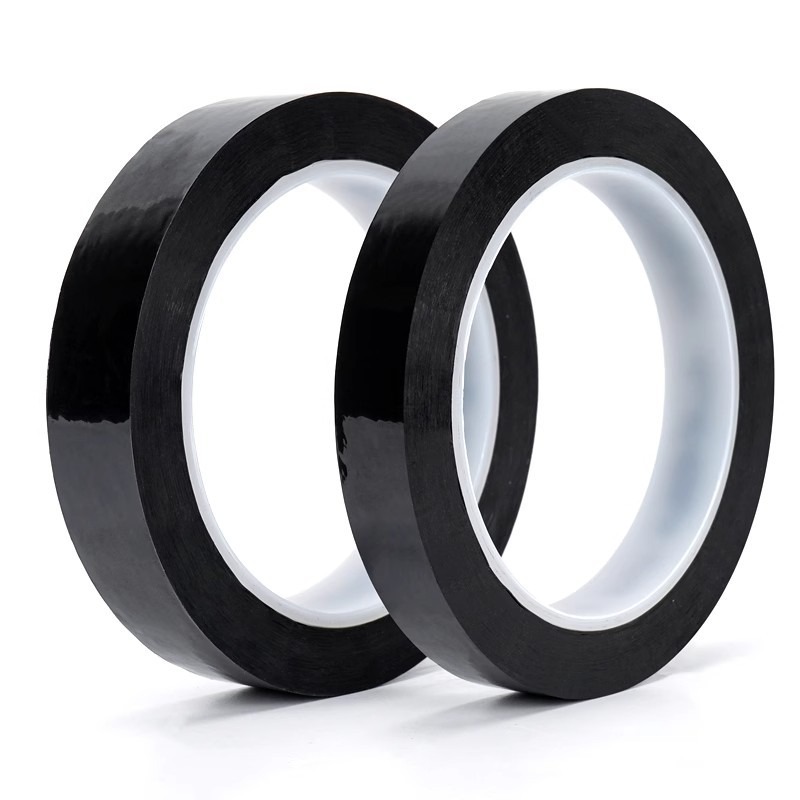
Black PET film with a single-side acrylic adhesive, developed for backlight (BLU) and LCD module assembly. The specification that matters is what it does not do: it is fully opaque and non-conductive on the adhesive side, so it seals light at the edge of a module without shorting the circuitry behind it. Adhesion, holding power and heat resistance are set for module assembly, and the construction is tuned for clean die-cutting and low squeeze-out in automated placement.
| Property | Typical value |
|---|---|
| Backing | Black PET film |
| Adhesive | Acrylic PSA, single side |
| Color | Black — gloss or matte as specified |
| Total thickness | 0.045 mm |
| Light transmission | Fully opaque |
| Conductivity | Non-conductive on the adhesive side |
| Key properties | Opaque; heat resistant; strong adhesion and holding power; good die-cutting; low squeeze-out, low residue |
| Typical use | Backlight unit (BLU) fixing; LCD module light sealing; preventing light leakage in LED and LCD displays |
Thickness, surface finish (gloss or matte) and die-cut tolerances are confirmed on the specification sheet.
Start from the function, then from the temperature. If a job sits between two families, send Songyang's sales team the process temperature, the surface and the electrical requirement, and the grade is confirmed from there.
| Your requirement | Recommended tape |
|---|---|
| Transformer, motor or coil wrapping; capacitor outer insulation | Polyester (PET) film tape, acetate cloth tape |
| Reflow or wave-solder masking of gold fingers and solder joints | Polyimide (PI) tape |
| Bobbin margins and winding isolation in transformers and inductors | Transformer margin tape |
| PCB handling, component packaging and ESD protection | Anti-static tape |
| Enclosure grounding, EMI shielding and signal-path protection | Conductive copper foil, conductive fabric and conductive foam tapes |
| Backlight and LCD module light sealing and fixing | Light-shielding tape |
Anti-static tape and conductive tape are not interchangeable — one dissipates charge, the other carries it. Where a joint has to stay electrically continuous through the bond, specify a conductive adhesive rather than a standard acrylic.
Slit from 3 mm to 1,300 mm to match dispensers, winding equipment and die-cut tooling (subject to model).
Shapes, gaskets and display parts die-cut to a drawing or a physical sample, with release-liner options.
Private-label cores, printed text, labels and export cartons produced under your brand specification.
MOQ, sample schedule and production lead time for your model are confirmed in the quotation — consult Songyang's sales team.
Songyang supplies specification sheets, TDS and MSDS for each family, plus samples for line trials. Send the application detail with your enquiry and the grade is matched before the order. More grades, colors and custom die-cut shapes are produced — sample photos available on request.
Songyang manufactures electronic tape at its own plant in Houjie, Dongguan, Guangdong — so overseas buyers deal directly with the production line instead of through a trading layer.
Ordering from Songyang's own plant removes the trading margin between buyer and production, and puts specification questions straight to the people who run the line.
Compounding, coating, converting, slitting, printing and QC all run in-house across 16 production lines, backed by 28 years of tape and film know-how.
Raw films, adhesives, release liners and tooling are clustered around Dongguan, which shortens material lead time and supports sampling in 5–30 days.
Songyang ships to B2B buyers worldwide, supports EXW and FOB terms, and supplies commercial documentation and technical data sheets with the goods.
Songyang is a China-based manufacturer (Dongguan, Guangdong) serving global B2B buyers directly — 9,000+ m² of plant, 16 production lines, 5,000+ specifications and 5,600+ customers served. Made in China, engineered for export.
Values are typical ranges; final specification is confirmed against your application. Minor batch variation may apply — confirm with our sales team.
| Parameter | Value |
|---|---|
| Groups | Insulation & heat resistance / anti-static & conductive shielding / assembly |
| Insulation | Polyester (PET) film, polyimide (PI), acetate cloth, transformer margin tape |
| ESD & shielding | Anti-static, conductive copper foil, conductive fabric, conductive foam |
| Assembly | Light-shielding tape |
| Thickness | 0.045 mm to 0.45 mm by family — 0.045 mm light-shielding tape through to 0.45 mm triple-layer margin tape |
| Temperature | −20 to 300 °C (−4 to 572 °F) across the series; grade confirmed per application |
| Surface resistance | 1.00×10⁶–1.00×10⁹ Ω anti-static; ≤ 0.05 Ω conductive foil and fabric |
| Shielding effectiveness | 70–90 dB (10 MHz – 3 GHz) for copper foil and conductive fabric |
| Widths | Slit from 3 mm to 1,300 mm (subject to family); 1,270 mm (50 in) jumbo for acetate cloth |
| Customization | Slitting, die-cutting, release liners, printed text, private label |
| Packaging | Rolls, spools and die-cut parts; export cartons to buyer specification |
Send specs and quantity — we reply with a quote and technical suggestion within 24 hours.